
Painting process | Pine Tree, Koroni
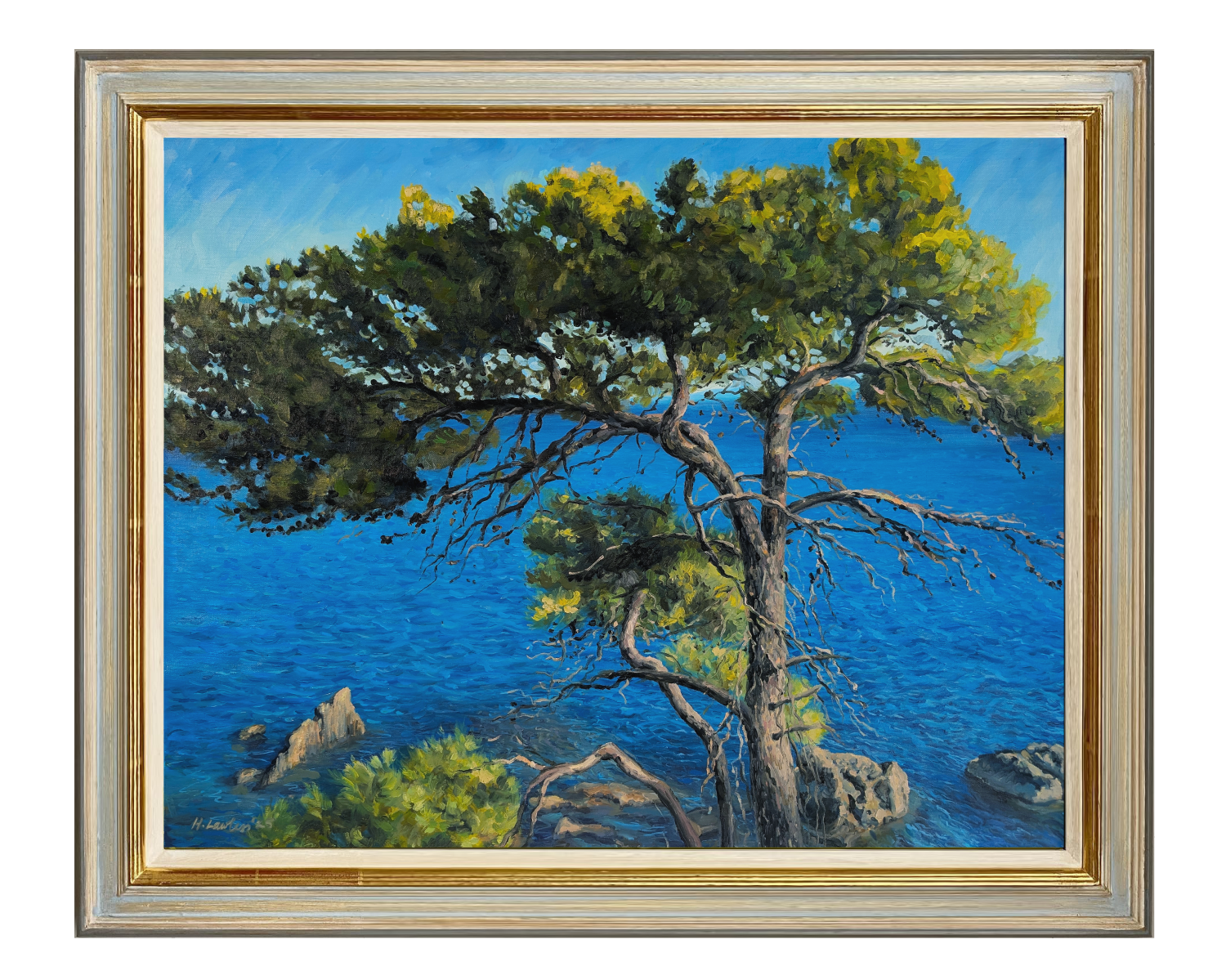
This painting began on the castle walls in Koroni, when a pine tree caught the light off the water and made me pause. The view felt strikingly unusual as I was looking straight into the tree while also looking down to the rocks and out to the Mediterranean sea, with the horizon mostly hidden behind branches.
I wanted the painting to feel like summer on the Med. Bright, vivid, the way a holiday day feels when the air is warm and the light bounces off everything.
Some paintings flow seamlessly from idea to finished painting… but this was not one of them! This painting took me three attempts! For the first, I fiddled too much and ended up with a muddy canvas with none of the Med sparkle - and it was relegated to a study. The second was a very simplified version that missed my own voice. And for the third and final version, I ended up trusting my artistic instincts and how I want to paint, which was a valuable lesson! The finished piece feels like the sculptural still-life landscape I’d hoped for. And I’m glad I pushed through. I hope you enjoy seeing the process behind all of this here.
“Pine Tree, Koroni” will be released with my new collection, online on November 11.
Preliminary sketches and studies

I started out drawing the tree a few times, working on the structure and mapping out the darks and lights. It’s not my usual subject, as it’s less landscape and more still life which posed some new challenges for the composition. This painting is less about creating depth and variety, as there is a very dominant focal point in the foreground. It was interesting to create interest in a less expansive scene than I’m used to. To me, the interest in this painting lies in the yellow/blue colour combinations, the unusual down-and-out perspective, and the distinct seaside light.

Here’s a little colour study I did, turning the black and white drawings into sunlit colour. This first, messy sketch helps me to work out the colour mixes. They don’t end up the same in the final painting, because I learn a lot from these not only on what to do but also what to avoid for the final piece. I love these little paintings, they have a life of their own!
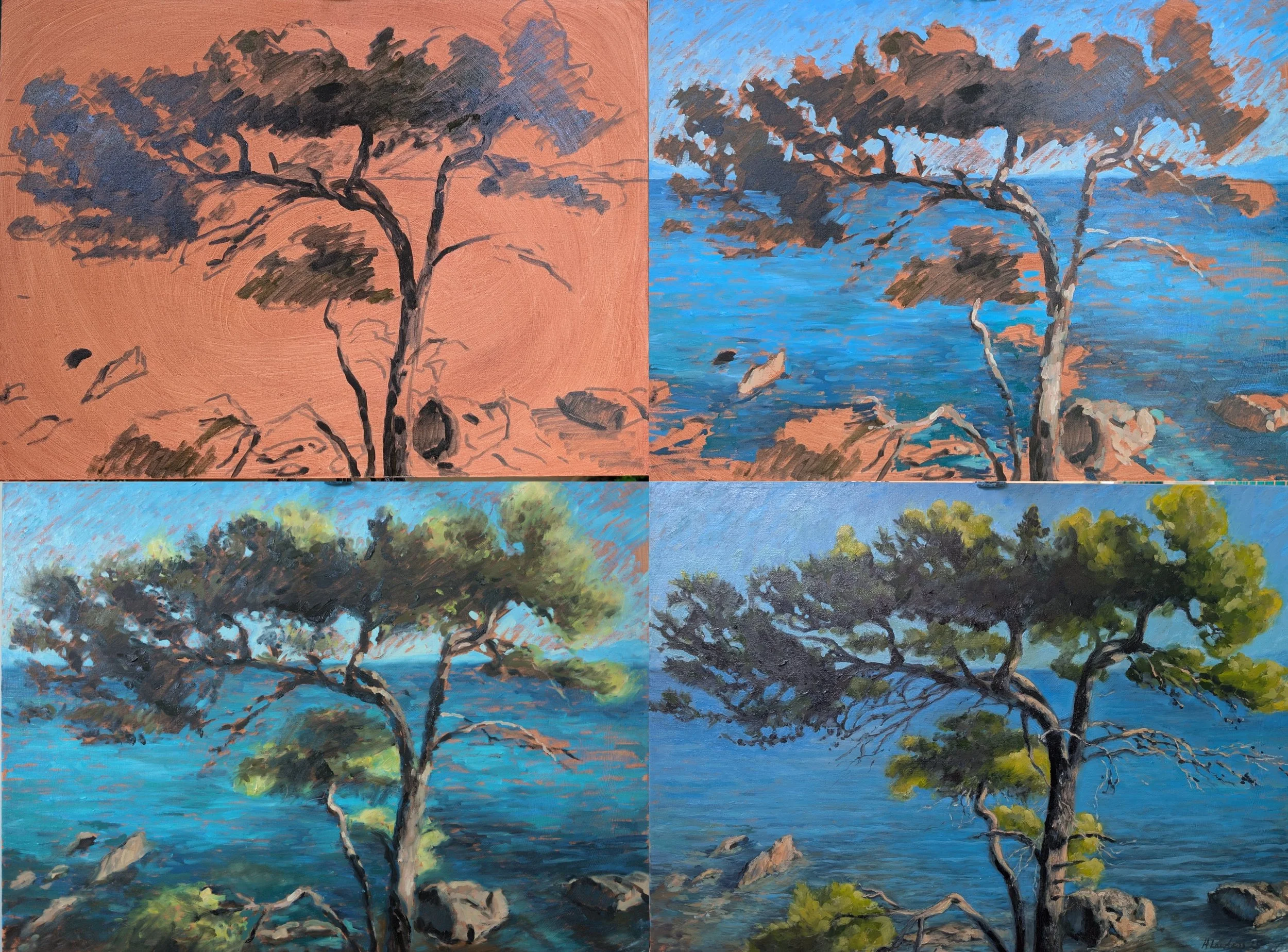
Then I hit a wall - I had a bit of a crisis of confidence with this painting! This was my first attempt, which I abandoned after fiddling with it for too long. You can see in the third picture the colours were very similar to my sketch. It lost its freshness and was becoming muddy. There was no fresh Mediterranean sparkle left here and no amount of reworking would bring it back to life.
So I suppose this one counts as a study too, and taught me a lot about sticking to my guns with how I want to paint.
The painting process

So here’s the beginning of painting number 2. I was simplifying the shapes within the leaves to help arrange them in a way that clearly communicates and give them a visual hierarchy despite their chaos in real life.

Here’s the first layer complete, with very simplified mapping of the colours and value shapes, just to set the stage and give me a framework to work within.

Here I’ve started adding in transition values between the simplified shapes to start creating form, variation and depth, particularly in the leaves.

I then brought in more variation within the big shapes to sculpt the tree and rocks.

This was as far as I took my experiment with simplification, and what I consider painting number 2. While there are passages I enjoy in this painting, it just didn’t feel like my style. I sat with this version for over a month, considering my personal style and whether I was happy with it as is. It was a good exercise but ultimately I decided to bring back how I want to paint and not fight against it!

Here you can see me adding more detail over the water and rocks on the right side of the tree, which contrasts with the old version remaining on the left side. I created the texture of the water with many layers of different blues, looking to give the illusion of depth by fading the detail out in the background.
To me, this change is more true to life and creates that wonderful bobbing texture of the Med.

Here I added in the texture I felt was missing from the bark and leaves too. This tree was craggily, layered and wild. That texture is what brings it, and the painting, to life.
Finished!
“Pine Tree, Koroni”, 80x65cm, oil on canvas.
Those finishing touches were worth it, and I loved painting this sculptural still-life landscape!
This painting didn’t flow easily from my paintbrush, but it felt really satisfying to push through, start fresh, and come out with a painting I’m truly proud of.

Details
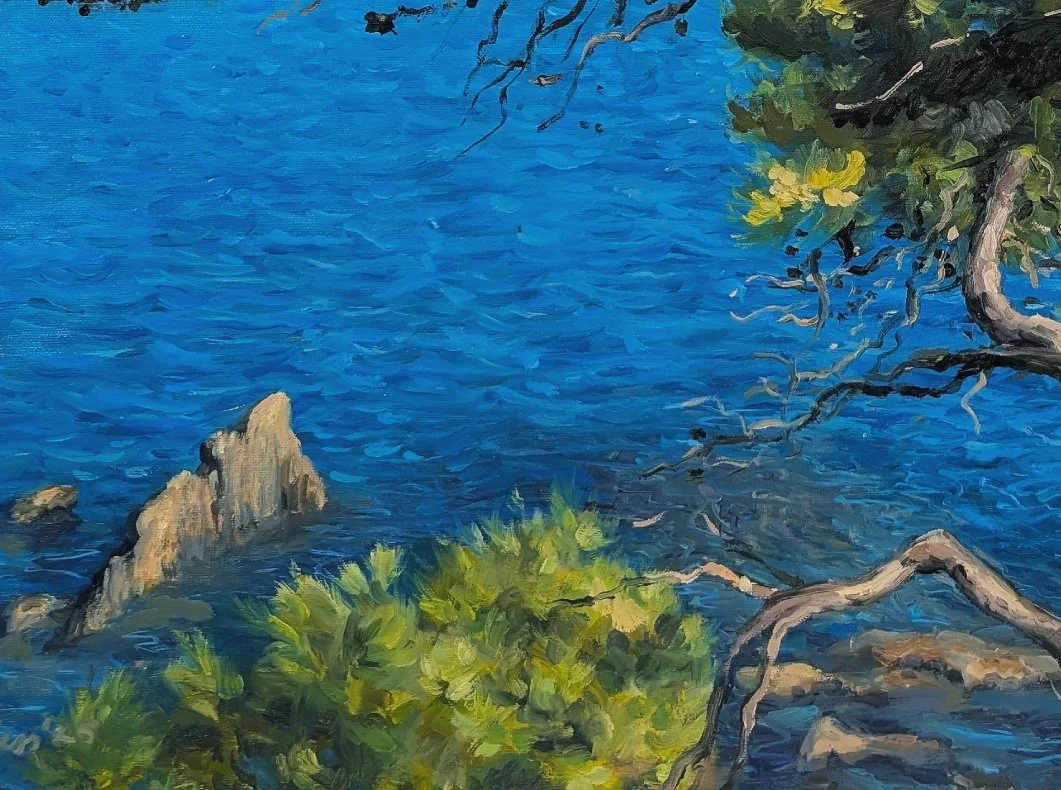
I’m especially happy with how the rocks underwater are convincingly see-through and the sea is gently rippled without competing with the texture of the tree.
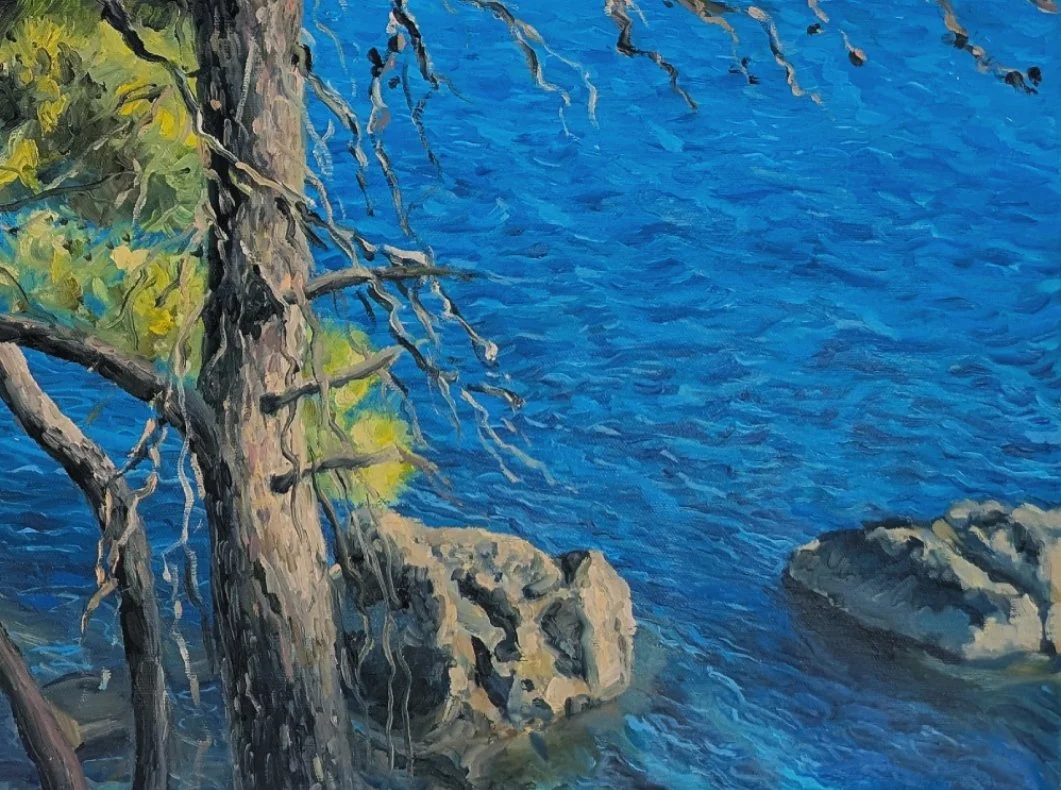
The pine tree has so many gnarly little branches that really give it character. Painting these was really fun!

The tree mostly obscures the horizon, but you can just see that there’s light-blue land in the distance between the branches. The viewer’s eye isn’t drawn into the distance like it would be in a more conventional landscape painting, but there is intrigue on the horizon if you look for it.
The yellow of the sunlit leaves was tricky to mix without it going too orange or too acidic, but I think I struck a good, convincing balance. It took many, many layers to build up the texture of the pine needles, while being careful not the veer into too literally into painting each individual needle!
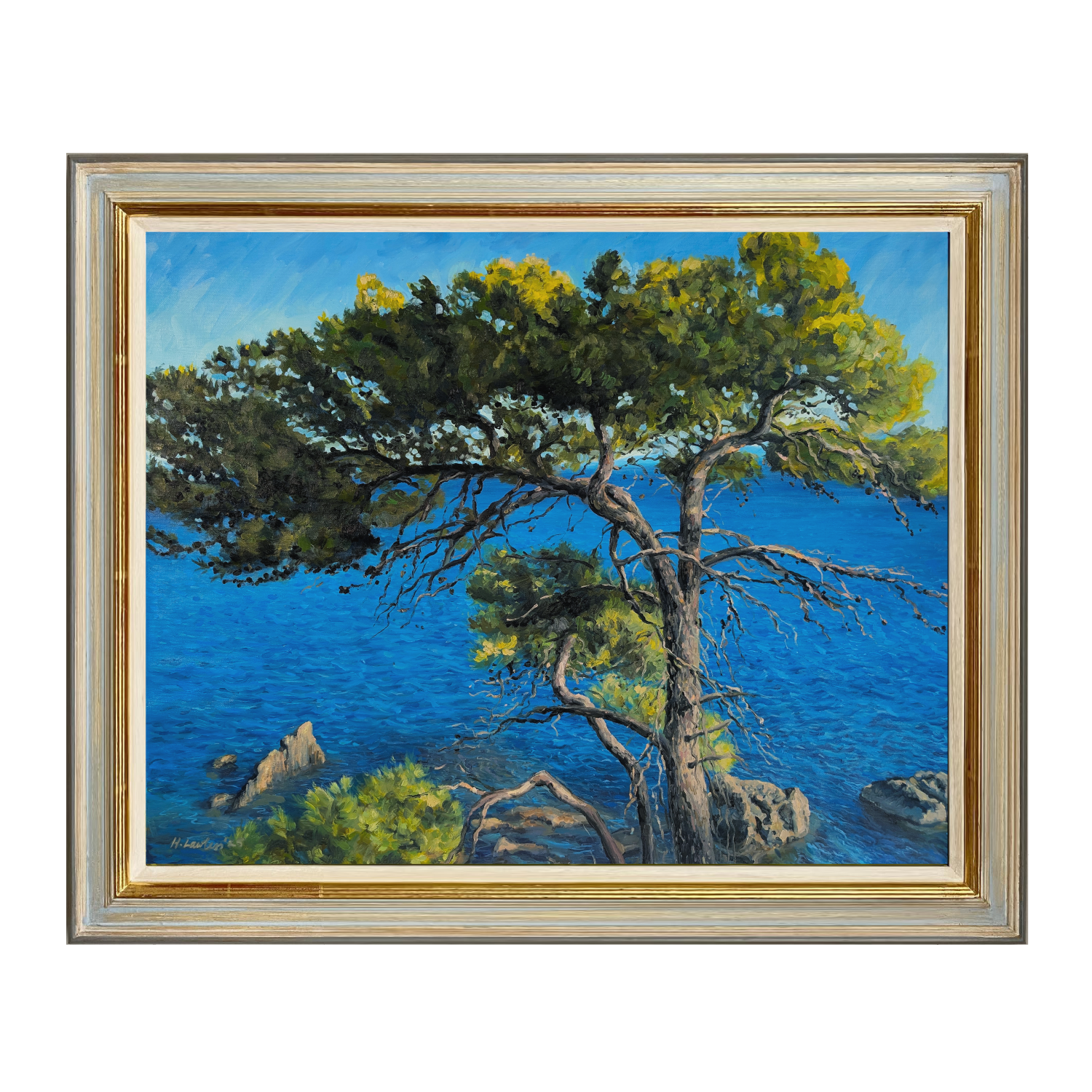
This painting began on the castle walls in Koroni, when a pine tree caught the light off the water and made me pause. The view felt strikingly unusual as I was looking straight into the tree while also looking down to the rocks and out to the Mediterranean sea, with the horizon mostly hidden behind branches.
I wanted the painting to feel like summer on the Med. Bright, vivid, the way a holiday day feels when the air is warm and the light bounces off everything.
Read the story behind this painting →
Details
Medium: Oil on canvas
Size: 80x65cm (before framing)
Framing: Premium custom framing included.
Shipping: Worldwide shipping included.
Included With Your Painting
Your painting will arrive expertly framed and ready to hang. International shipping is included.
I also include a ‘Story and Care’package to help you display your painting beautifully, look after it easily, and share the story behind it.
It includes:
Premium handmade and hand-finished custom framing
A beautiful hardcover story book documenting the inspiration and creation of your painting.
Original sketches and studies
Signed certificate of authenticity
Curated hanging and care kit and guide
Custom greeting cards
Custom decks of playing cards
Fully insured worldwide shipping
How To Buy
Click “Enquire to Buy” and fill in the form. I’ll personally confirm availability, answer any questions, and send you a secure invoice.
Delivery and Returns
Framing and delivery typically takes around 12–14 weeks, depending on the design and time of year.
I offer a 90-day money-back guarantee. You can read more here.
Newsletter
Subscribe to my newsletter if you’d like to hear the story behind my future paintings.
